The Bridge Hoa Han—1
author Văn-Nhân
translated into English by vanthanh
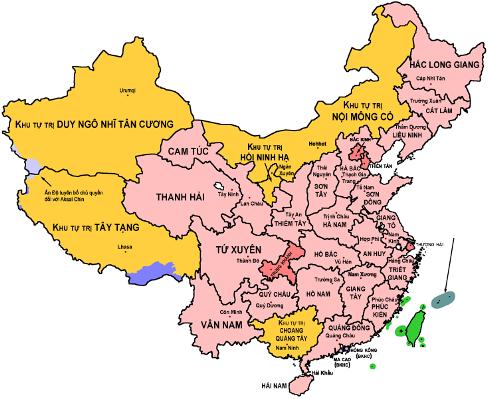
Han people called themselves “Guān ( 官 ) national”...;.
“Guān national”...;. who are you..?
In China today the Beijing also known as mandarin language ( 官话 Guānhuà ) is considered to be the universal, the word “Guàn 官” is understood as the man with Droit, quan – is the foreman, people rule the population, with the mind of power. In a period of history that the people and the ruler was not jointed with same interest, if there is the speech of the people-- ruler, there is also speech of enslaved population. This event has something to say? Clearly this is the case of a nation dominated by foreign aggressive people who come over. The Guān ( 官 ) national is a governed Mandarin, so the people who are being ruled, who are they? In historical context we are considering-- is only can be a mere Chinese—ancient Yueh. There are two totally different kind of people: Guàn= Northern China ’s Han. and Chinese—is the south China or China of the original past. (but in the past, when the north is south, south is north, so Gua`n means South of ancient China( Yueh).
Mandarin language is the language of the Shaanxi , Hebei , Beijing areas, is the ancient land of start-up sole king -- the Guangwu ( 光武 )—king of the Eastern Han or Later Han. From the meaning of Guan ( south )= ruler in Viet language, we already know why Han people called themselves Guan ( nam=nom (look after)-south ) race.. In other words:
We see the complete clear connection around different words:)., and mandarin language: Guàn speech of Guan/Han chinese,
chinese language have 3 homophone of the same word Guan as following: a) Guan: Guānhuà Guàn national – mandarin ethnic group they are in the contact with the GUÀN: the ruler Han (current china)
b)Guang, means– clear, cloudless-- as in the name get-Guang National Later Han king Guangwu
c)Guan, means look – vision: nhin, nom in Vietnamese: nom ....' 'sound again agree with' nam 'is the south. The south is "the nom" translated into Chinese as' the guan direction '(nowadays the south is transformed to the north—see previous articles in the historical and I ching parts)
–in the case of the name of the king:It would be wrong to use the word Guang ( 光 ) for Guangwu king should be Guan-wu—the correct historical name for him, is Guan-wu: King of Guan (Guan mean south ).It should be Guan wu (King of guan () race—King of south) In Vietnamese language vu means king (as vu sounds similar to vua (king)
It is unknown why the word Guang has been used instead of Guan in the name of the King—forefather of Guan/Han Chinese current ruler of a majority of non-Han China in the past.
The reason why Chinese Han race (current China) have replaced the original word with similar pronounciation word is they want to change the meaning of the word guan as (south—country in the south of ancient China--Yueh), turns it to the second meaning of guan (bright, clear) in order to remove the origins of An Old Civilization: Country China—Yueh. In reality, what the word Guan that the origins of Chinese—Yue wanted to tell, is South and not bright. To remove the text the- Guan: south and replaced by - Guang (bright – clear) ....in the name Quang Vu king -- National Later Han forefather is the intentional replacement.
In more detail: - the- Guan, look - nom. ....' in Vietnamese nom 'sound again agree with' the south'. Southern direction, location is also read homophoneticly: nam= nom (look after). The translation into Mandarin language is' the “Gua`n direction”, (which with current reverse direction is the northern direction). Guangwu is the real king of Nom=Nam=southern direction = Mandarin people. In the past, the original Chinese=Yueh calls the king of the foreign country in the south (and not their country): King of the South: with south=gua`n: means Guànwu.
Continue with question: tribe Mandarin who are you?. Upstream history to Chinese Yin dynasty's –a most prosperity dynasty: At that time,Shang-yin have 4 under nations. The Book of History write: In the south (of Shang-Yin) is Mandarin (named Guang)country, East is Tu*`country, West is zhou ( Chu ). North is Thao (fly )country. We shall talk about Thao ( fly ) country latter, as with that topic, have to spend a whole long chapter to penetrate. Han people called themselves “Guān ( 官 ) national”...;.
“Guān national”...;. who are you..?
In China today the Beijing also known as mandarin language ( 官话 Guānhuà ) is considered to be the universal, the word “Guàn 官” is understood as the man with Droit, quan – is the foreman, people rule the population, with the mind of power. In a period of history that the people and the ruler was not jointed with same interest, if there is the speech of the people-- ruler, there is also speech of enslaved population. This event has something to say? Clearly this is the case of a nation dominated by foreign aggressive people who come over. The Guān ( 官 ) national is a governed Mandarin, so the people who are being ruled, who are they? In historical context we are considering-- is only can be a mere Chinese—ancient Yueh. There are two totally different kind of people: Guàn= Northern China ’s Han. and Chinese—is the south China or China of the original past. (but in the past, when the north is south, south is north, so Gua`n means South of ancient China( Yueh).
Mandarin language is the language of the Shaanxi , Hebei , Beijing areas, is the ancient land of start-up sole king -- the Guangwu ( 光武 )—king of the Eastern Han or Later Han. From the meaning of Guan ( south )= ruler in Viet language, we already know why Han people called themselves Guan ( nam=nom (look after)-south ) race.. In other words:
We see the complete clear connection around different words:)., and mandarin language: Guàn speech of Guan/Han chinese,
chinese language have 3 homophone of the same word Guan as following: a) Guan: Guānhuà Guàn national – mandarin ethnic group they are in the contact with the GUÀN: the ruler Han (current china)
b)Guang, means– clear, cloudless-- as in the name get-Quang National Dong Han king Guangwu
c)Guan, means look – vision: nhin, nom in Vietnamese: nom ....' 'sound again agree with' nam 'is the south. The south is "the nom" translated into Chinese as' the guan direction '(nowadays the south is transformed to the north—see previous articles in the historical and I ching parts)
–in the case of the name of the king:It would be wrong to use the word Guang ( 光 ) for Guangwu king should be Guan-wu—the correct historical name for him, is Guan-wu: King of Guan (Guan mean south ).It should be Guan wu (King of guan () race—King of south) In Vietnamese language vu means king (as vu sounds similar to vua (king)
It is unknown why the word Guang has been used instead of Guan in the name of the King—forefather of Guan/Han Chinese current ruler of a majority of non-Han China in the past.
The reason why Chinese Han race (current China) have replaced the original word with similar pronounciation word is they want to change the meaning of the word guan as (south—country in the south of ancient China--Yueh), turns it to the second meaning of guan (bright, clear) in order to remove the origins of An Old Civilization: Country China—Yueh. In reality, what the word Guan that the origins of Chinese—Yue wanted to tell, is South and not bright. To remove the text the- Guan: south and replaced by - Guang (bright – clear) ....in the name Quang Vu king -- National Dong Han forefather is the intentional replacement.
In more detail: - the- Guan, look - nom. ....' in Vietnamese nom 'sound again agree with' the south'. Southern direction, location is also read homophoneticly: nam= nom (look after). The translation into Mandarin language is' the “Gua`n direction”, (which with current reverse direction is the northern direction). Quang vu is the real king of Nom=Nam=southern direction = Mandarin people. In the past, the original Chinese=Yueh calls the king of the foreign country in the south (and not their country): King of the South: with south=gua`n: means Qua`n Vu.
Continue with question: tribe Mandarin who are you?. Upstream history to Chinese Yin dynasty's –a most prosperity dynasty: At that time,Shang-yin have 4 under nations. The Book of History write: In the south (of Shang-Yin) is Mandarin (named Guang)country, East is Tu*`country, West is zhou ( Chu ). North is Thao country. We shall talk about Thao country latter, as with that topic, have to spend a whole long chapter to penetrate.
“Belonging to Southern of the nation is the country named Guan”. Using the same deducing method, we immediately recognize: Guan country is Southern country of old china (Yueh). Nam is pronounced as Nom in old days: meaning of Nom is Seeing. How you get this seeing word? Because in the past, the heaven and earth and sunrise and sunset are the kernel fourfolds that was first recognized. The heaven beyond the earth below, the sunrise on your right and the sunset on your left. Sunrise on the right with the reason that it brought positive energy: yang, goes along with other parameters such as righteous,respectful,higher position, and so on. So when a man is standing with correct position, his right handside should be “muc”, which reads as mat (right)-- the sunrise direction, left handside called “chieu” reads as trai =left/ on the sunset direction. So with this position of standing, he sees right/opposite to seeing wrong: which is SEE=Nom (Vietnamese). and the word Nom is pronounced as Nom, variable spelling as Nom: Nam in Vietnamese is south. In other articles in the series history and civilization, the reverse direction in the past between northen and southernm have been repeatly explained in more details: the south in current map, is north: North in Vietnamsese is Bac—Buc (hot—closer to the equator), is southern direction of nowadays conventional maps.
In short, both the North and South were signed by Vietnamese language: Buc = Bac= North; Nom = Nam (seeing when standing with left (chieu) in the left and right (mat) in the right. Therefore the south is reverse to current southern direction. It is the current northen side of the world nowadays.
nom (see) = South. So under the National "Quan" means the country in the south of central ancient china only. It means the Quan=Nom=South of old China is the area of Beijing –Sontay—Habac—a sub-country of Old China and NOT China of ancient civilization. What if we use the North and South as now, it is impossible to have a Mandar Guan sub-country as stated in the Ancient Book == on the South of China is country Guan (Han). Because then, China will have to go up to Mongolia to have Guan in the south of itself.
The reverse north south also fail to be correct if take the country Old China identified as areas Shaanxi - Hebei - Beijing, the land of South of which have to be Mongolia ..., Could happen this: Mongolia is Quan?
(Starting from this line, the person name and land name …to be named in Vietnamese)
If the aboved notions can not be, then can only be the follow: In the past, the North-South direction was set reversed. Only if the land of the An—Thuong dynasty of Old China/Yueh=Viet was settled in Ha Nam, Hubei, An Huy—south of Yellow River, the land of Guan --Han ethnic group was in Beijing area now: Tay Son - Ha Bac and the country: "Tu" is in Tu Chau Son Dong in the east.
Across the Chau dynasty, the words in the Book of History _Lo su of La Bi of Tong dynasty around 5000 years old book, write:
"Thuc, Ngo, Viet, So, are the land of Man (Ancient China---Viet),Tan Lung Tan Nguy are land of Dich, Ha Nam is land of Man, Ha Tay is set on Dich, Hoài is a place of Minority groups, Nguy has also its minorities. Everywhere the Man and the dich population living in. The, only at Vuong thanh region, many ethnic coexist: they are Nhung, Cu, Duong, Tuyen Cao, Luc Hon, Y luc living in the alternative with each others, within that mixed areas, the people of Han: Guan --just a group, not having many people.