author Văn-Nhân
translated into English by vanthanh
The Bridge Hoa Han– 2
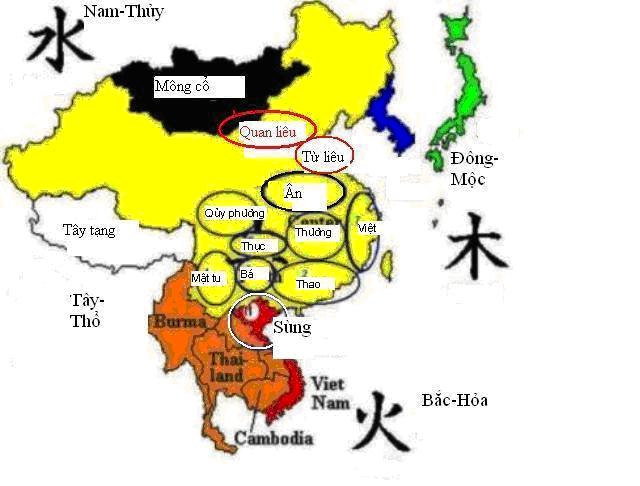
Lac duong in this historical period is the capital of East Ha~n country, means Eastern Han, we should not mislead to the Lac duong of the Eastern Chau dynasty.
Information in text on identifying "the Guan" still in the north "Hoang Ha", the Son Tay Bac Ha, and if you link with geography - history - "An Thuong" then we must understand the people that the book history “ Open History—Lo Su” called "Man and Dich" is indeed the name for the Old Chinese—Yueh—the real descendents of “An Thuong age. And An Thuong are descendence of the One Hundred Hung—Viet archaic national.
To look more closely, in the Chinese history at least from An Thuong dynasties, never the ancient Chinese can own the land of northern Yellow River stably and permanently.
- Time: An Thuong Chu we already know at the above.
- TimeTa^`n (Shang?): After unification of the Six nations, the barbarian encroached to Ha Nam.
- Time Western Han: after the Han So Tranh Hung (War Han – So) Luu Bang took the thrown, is clearly also the time the barbarian encroached land in Ha Nam, Luu Bang must fight, almost loosing his life to save the state capital. And, in the time of Han king Vu de, the enemy encroached southward up to Hoang Ha,,,
- From the time of the barbarian “Luc Lam Thao Khau "from the north of China, people of Han Tộc started from Son Tay, Ha Bac gradually encroach from North China to South China, took China and set Chinese/Ancient Yueh within slavery over 500 years.
Until the Duong (toong?) dynasty, the China--Yueh could take back the country up to northern Yellow river, for a short time and not as stablly, and permanently. The war caused by barbarian anlocson prolonged for some ten years, An Loc Son is clearly can only be the. Northern barbarian “mandi people".
.... More later on, China becomes more suffering; Ha Tay, the Lieu, the Kim, the Mongolia and ultimately is Man Thanh, China is under agression from the hundred years and only from the revolution Tan Hợi 1911, but since it takes on a different new dependent reality: non equality, but this time is more hidden: National cooperation HAN-HOA, China’s Han is the Quan—ruler ethnic group. That is the reality today. China can not say its brilliant past, 10000 years old civilization,as its past were twisted, destroyed, hidden to serve the new onwner—the invasion Guan—enemy of its ancestor. In sum, under viewing angle combination Han (Guan nationa)l and Hoa (china original)---the distant past is no longer enliven in the history of Chinese again, and therefore we have a story that the new invasion (Guan, Mongolian, Man Chu people) occupied China and set China under their horseshoe also become a dynasty
.The Guan and other invasion dynasties originally means the actual time in history-- occupation of Chinese, destroy the root of china, physically, and mentally: brainwash is the goal of the occupation races: the age that all Chinese traditional ways have been force to the hairless style: people in the past keep hair as a swear to keep tradition. The ruler Han force them to forget this mentality, with the new style. But finally the Chinese people negotiate to have a style which is: a half head with hair and half without hair. Under the new regime Han ruler, family cannot have their freedom, 10 families can obtain 1 knife, and the intellectual people become the lowest class: 9 per 10 from low to high, which means just higher than the beggar under class of the country Han Hoa at that time, under Mongolian invasion.
.Quan together with Lieu become a dual word, since: "Quan Lieu" in the Vietnamese word pair to the second part: “Quan Lieu Hong Hach”= "Quan Lieu authoritative bureaucracy" for the attitude of the Guan rulers that consider people like garbage to be ruled, exploited. The issue that also should determine is the country Guan and Lieu is the only one country: accurate to say is: The Guan country of Lieu people. "Lieu" is a negative term from the word "Lu". “Lu” in Vietnamese means blurred, small, black, fuzzy, cold, low,
dark, the significant nature of places with cold climate --Southern state (reverse to the south today)
Guan originally means Southern, but because the actual time history of Chinese occupation is ... all the people from low to high are under "Guan ". So the Guan should have a new meaning: " governed domination, or a people with power, right, as now we understand.
Tộc Han, Quan Tộc, Lieu Tộc is Chinese or not? Here we can see one more historical prove:
Lieu/ Han occupied land of northern Hoang Ha's (Yellow river) of China, Kim killed and occupied land of Lieu, then add in all the occupied land of Hoa Bac, Mongolia occupies the land of Kim and occupying troops take Southern Tong in the south of Zangtzu.
Mongolia divide people into the former population of old Kim land, and called Kim= Han Guan, the Nam Tong called Nam-man. So to the king of Mongolia there are two kind of people : the Kim Lieu is Han Chinese and the rest others are Chinese.
If we ask the question, who is Han Chinese or the Nam- is Chinese, a baby also can answer immediately: The country's Southern Tong is Chinese, and still more in China from the past, "Han people "be used as a bad word, slang, when people get angry, they use “Han” (Book: The origins of cultural resources by Chinese author Duong Dac Nhan Editor, issued in 2003 in Vietnamese).
So why until now the population still mistake Han is Hoa or the Han Chinese and the Hoa Chinese are only the same people regarding ethnicity? Han Chinese and Hoa Chinese are the two peoples is that they are not only two distinct nations, but even they are difference of race. The Han people aligns to Mongoloist, and the rest Chinese belongs to the Mongloit southern line with a 2: Asia and the South Island (The path of History BOOK (Lo Su) called them the Man and the Dich)
The mistaken is not due to the redundance, the result has a sort of intension and it is very sophisticated. Let review the history of China around the first years of Christ-- Western Calendar, at that time, the term Han was converted to replace China (Hoa).. through the historical” bridge”irony of history.
The King at that time named Mang (Vuong Mang), with a range of comprehensive reform, has put Chinese society in a turbulent disorganize period. This chaos adding with the foreign invasion by Hung No, the northern minority and the long period of natural disasters, all together push China (ancient Viet) into an turmoil gulf edge
The country with almost no power ... of course the viscious barbarian emerged everywhere. One decisive decision for China destiny happened when the king Mang abandoned the names kings for former sub-country king, let them down to Hau^` position which is much lower than king’s position. He also banned the Luu clan, not allow them to participate as leaders of China. The distinction between Chinese and (Ancient Yueh) Non Chinese was very strict.. He banned them ie Save RESOURCES dumb people are not participating in the leaders of China, the distinction between the Chinese and foreign people, the country and belong country.
King Mang seemingly want to restore the continuity of national tradition of "Chau " dynasties, the country's "Asia" traditional king network.
The conventional history do not say, but many researchers have shown that by the time the state of Han –So fighting for power, there have many Hungno-- the Northern barbarian in general participated in the army, and gained reputation. After Luu Bang moved up to the Thrown, the country organized as a National State a minority community. The Chinese Emperor’s family also strengthen relationships with race in the north by many marriage, that is why many people has original Hungno blood has become aristocrats in the dynasty.
Two brothers Luu Dan and Luu Tu are two officials in the minority race, when king Mang took their position names they immediately react, training of those who are board in the same boat. They occupied mountain Luc Lam in Ho Bac, in the initial just a gang robbed, the Chinese defied, called "glaucous Railway Workshop" ... but when the nation was falled to dark period, the robbery also could make victory.
China dramatically turn to the fall, thinning so only a light wind is enough crash it. In the beginning, the grass root character gangs, original " low vision people", nominated Luu Huyền as king, the established king named his kingdom “Han country”.
The mistaken is not due to the redundancy, the result has a sort of intension and it is very sophisticated. Let review the history of China around the first years of Christ-- At that time, the term Han was converted to replace the term Hoa. Through a “historical bridge”—an irony of history.
The King at that time named Mang (Vuong Mang). He did a range of comprehensive reform that put Chinese society in a turbulent disorganized period. This chaos adding with the invasion by foreign northern minority groups named Hung No. All are added with long period of natural disasters, all together push China (ancient Viet) into a turmoil historical ages.
The country with almost no power ... of course the vicious barbarian emerged everywhere. One decisive decision for China unlucky destiny happened when the king Mang abandoned the names kings for former sub-country king, let them down to Hau^` position (much lower than king’s position). He also banned the Luu clan to become an authority person, and forbid them in participating in high ranking leadership of the country. The distinction between Chinese and (Ancient Yueh) Non Chinese was very strict
King Mang seemingly wants to restore the continuity of national tradition of "Chau” dynasties – which means the country's "Asia" traditional king and leadership network.
The conventional history did not mention, but many researchers have shown that by the time the state of Han –So fighting for power, there have many Hung no-- the Northern barbarian in general served in the army, and gained reputation. After Luu Bang took the thrown, the country is organized as National State of minority’s community. The Chinese Emperor’s family also strengthen relationships with races in the north by giving their daughters marry northerners. Therefore, many people has original Hung no blood has become aristocrats in the dynasty.
Two brothers Luu Dan and Luu Tu are two officials in the minority race. When king Mang took their positions and titles they immediately react. They trained those who are board in the same boat. They occupied mountain Luc Lam in Ho Bac. In the initial just a gang robbed, the Chinese defied, called “grass root gangs in the forest” ... but when the nation was failed to dark period, the robbery also could make victory.
China dramatically turns to the fall, thinning spread, so only a light wind can enough crash it. In the beginning, the grass root character gangs, original “low vision people", nominated Luu Huyền as a king. The so called king named his kingdom “Han country”.
King Canh thuy (Luu Huyen) stays at the thrown for 3 years, then was defeated by the Xich my, with the Army Chain of Taoist Chinese, rising to restore state dynasties of Luu Bang. LuuTu is the Great strategist, the national hero of the Han. His followers are people who terminates the life of Chau Hoang De (King of the Chau/ ancient Chinese/Viet) when the king is in the course of meditation at the thrown, as the king thought his destiny is still in good shape.
But under the Canh Thuy dynasty, Luu Tu is doubt by Luu Huyen, and he is propelled by Luu Huyen to remote areas in Northern regions. Previous time, due to fighting each other, Luu Huyen killed Luu Dan, the brother of Luu Tu.
Luu Tu was shown clearly his brave, after years quietly build up the force, in the 25th years after Christ, he climbs up confesses kingly title: Quang Vu, country and dynasty named Han or Hau Han.
As of year 26th Quan Vu killed Xich my and sequentially occupied china
4 Dynasties of Asia-King in different periods
1. Luu Bang Hieu Cao To dynasties of China -
2. Dynasty of Vuong Mang, Chau Hoang de
3. Dynasty of Luu Huyen—King Canh Thuy
4. Dynasty of Luu Tu, Quang vu king,
In this process, the issue of unusual of history was 2 dynasties: The first one: Luu Bang Hieu cao To and the second: Luu Huyen—Canh thuy.
In dynasties erected by luu bang. The entire kings have the official names as Hieu: Hiếu Cao Tổ, Hiếu Huệ Đế, Hiếu Văn Đế, Hiếu Cảnh Đế, v.v…
According to rule of Chinese history, this royal court must be called royal court “HIEU", but in history book of China, we do not see this title “Hieu”. It was changed into the " Western Hán”
Cánh Thủy Đế Royal court even more, is without both official name of a monarch and official country name. It doesn't make sense if it be " Canh?” country! There is no where to see historic writing about that? But a troop was mentioned as the army of Hán. Why so? Link 2 events, we could find the mystery of Chinese history
By logical interpretation, we see:
The revolutions of the "Luu" in the mountains Luc Lam lead to the establishment of 2 dynasties of “Han" Dynasty Luu Huyen in the Thiem Tay and Luu Tu in Habac –Beijing. If royal court of Luu Tu is Eastern- Hán the one of Luu Huyen is Western-Han or Tien Han. History clearly shows Luu Huyen’s army is “Han” army. For what reason the Han removed the title -- official name of a monarch called “Hieu” dynasty? When the “Han” name was officially given to replace the “Hieu”? The official Chinese country of Luu Bang dynasty--named of a monarch newly name, should be Western Hán or Later Han, instead of Hieu, to ensure to take possession of the true Chinese nation—Hoa/Viet and turn it to Han, to let historic smooth flow, the intermediate step, or the bridge--change the name from Hieu to Han, the historic bridge joins Hoa – Hán was smoothen -- letting the Han takes over Hoa. 'To seize' including the ancestry of Chinese, this is particularly "unique" in the history of humanity. The "transition" is set up very elaborately and sophisticatedly. Luu Bang, a Hoa/Viet King called the Bai Cong: in the war “Han-- So Tranh Hung” (two dynasties Han and So competing with each other), Luu Bang is given a new name: Han Vuong. From the "Han" is only similar to a word Hung/ which come from Hen= Hon (win over, better) “So” means sui (lost, unluck), Han-So is only a pair of I ching (up on the rule's opposite, dual pair)
Hán – Sở = Hên – Sui
Hơn – Thua
Hưng – Suy
The war Han-So is the war of two Viet (Hoa—True Chinese) power-branches.
The Han, in this case is totally different from the Ha~n with accent: ~. (Ha~n= the southern (northern nowadays) barbarian group (outside of China). We can confirm that Luu Bang is not a king of the Ha~n== barbarian group from the northern Lieu... (North monologist race). Luu Bang is a king of ancient Hoa/Viet.
The name Han and So comes from the phonetic similarity: Hen Sui, Hung Suy—as stated above (Han-Hen-win over, and So-Sui,suy (lost). As Luu Bang is the winner, surely is King Hung (dde^’), Hang Tich is the failure is become the suy de or king of so*? The magical word transformation allowed the Hung (winner)è Han = => Hãn. "Hung de" of China through the intermediary of the word "Han" has been converted into "Dai Han", (Dai=Big)è “Big Han” king of the Northern barbarian. The family name” Luu” –of Luu Bang is the made up confusion, intentionally. The Luu family name by phonetic spelling, is very close to the Lu—Lieu ethnic Ha~n (Han with accent ~)
About Luu Bang, he is not the Han King. His family name come from the Luu, which has the root from the word fire— native tropical region of Viet/ Hoa wet rice culture.
We can know that because: when at the revolution in the land of Bai, he has worship the Emperor Hoang De and Xi Vuu, which denotes he was pure Chinese/Bach Viet. He selected the official costume, and flag with red color, demonstrates he represents the original tropical domain, represented by the Fire element, in I ching fire is red. So he must bring the family name: Ly and can not have the family name as Luu. Luu is the phonetic variant sound of Lu-- "Lu means fuzzy-- is a feature of the Southern according to Dich ly/ Iching (as opposed to current direction north south).
Lu → Liêu – Lưu.
Lửa → Lý – Lưu.
In sum, only with a minimal phonetic change, a original king of the tropics turns to the great king of the cold areas.
In summary
In Chinese word "Han" or "Han Tộc" is the name of the two northern ethnic nomad tribes: major ethnic or Khiet and Dan Tien or Kim-man, the Quan Tộc is only a part of nomad Lieu Tộc.
Quan Toc, Han Toc is not Hoa Chinese, according to pure network of Chinese.
Country Han’ is never China. The Hieu dynasty established by Luu Bang should not have any blood’s contact with the country Quan Toc East Hãn Quốc, which is accurately should be called the country of East Han, with Western Han. Similarly Khám Sat - Hãn Quốc -- of Mongolian population.
Vương Mãng is written correctly Vương Mãn: That is, the last king. Ma~n is overflowing and can not be added again, use the Vietnamese word for the Man was well done as Mãn Nhiệm, pass out program: Mãn khóa finished parts, etc. ... by historical circumstances, the historian can only write a hint:Vuong Man dynasty-- the King Vương Mãng and we must understand the meaning is: the fate of China, the King has to stop. Compared with the common Hùng Triều thế phổ-- Hung system of dynasties, we see Mãng dynasty is the King Hùng (Hung Vuong) the 18th ..., Name Vương Mãng tell a very clear this is King of the last dynasty of Pure China, following are the series on the National lost: the Chinese people starts a period of slavery and who anticipate dominate China ---is the Quan Toc, or the Hãn Tộc with 2 Early and Later ones
The issue Luu Tu’ states himself a 5th descending generation of the King Cảnh thuy of Hiếu dynasty of Luu Bang –is a flaw, fake notion. The folk culture moked him: “mập mờ đánh lận con đen”-- opaquely deceive “black people” . The name Luu huyền and Luu tú-tối –mean Black (Luu=Lu= Lieu or Huyen and Tu all mean Black in Vietnamese. There are much more original Viet words from han written in Chinese history of language phenomena. This is not yet being explained ... it could be a Chinese history is now written in the original material must not be written by hán language: words or phrases. It very possible that the history of China is written based on not-Chinese language, and from a type of letter in a foreign language, so this kind of ancient language can only be the Viet/ Hoa ancient language, or otherwise—a letter provided by some people’s language very close to the Vietnamese language nowadays.